
Mother and Son
From the Closet to the Open Air

How Hamlet Ends 3
The basis of my work is the belief that voice and language belong to the whole body rather than the head alone, and that the function of the voice is to reveal the self.
-- Kristen Linklater
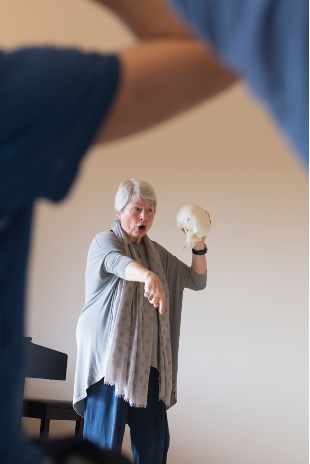
Dropping in: Mother and Son
The so-called Closet Scene – Act 3, Scene 4 – is a beast. Perhaps the most excruciating, most wrenching, most undiscoverable scene of the entire play.
Here it is performed by Andrew Scott and Juliet Stevenson:
Literary critics have been all over this bedroom encounter, hypothesizing like crazy -- but —
Actors have to go there.
So, rather than examine the many critical analyses of this primal confrontation (and believe me, there are a hell of a lot of them), Diogenes begins with the scene work he did with two gifted young actors back in the 1980s at Shakespeare & Company in Lenox, Massachusetts.
One crucial exercise is Dropping-In. The objective is to bring the text from words on a page to the entire being of the actor, mind, body, spirit.
The central nervous system governs the whole organism through continuous streams of images, be they auditory, olfactory, tactile, visual, impressionistic, or figurative. Images in voice work help to reconnect the acts of listening and speaking to the whole person. Listening is no longer attached just to the ear. Speaking is no longer attached to the dictatorship of the mouth. Embodied listening and speaking involve the whole person from feet to skull. The body is all ears. The body is one big mouth – KL
The Latin word for spirit is breath.
QUEEN
Be thou assured, if words be made of
And breath of life, I have no life to breathe
What thou hast said to me.
3.4:(219-21)
Throughout the dropping-In exercise, the two actors sit facing each other, feet firmly on the floor; body open, arms dropped to the side, relaxed and ready, constantly maintaining direct eye-contact, constantly breathing – breathing – breathing – breathing – breathing – breathing.
Allow the breath. . .
From the side, an assistant feeds them the text, in a neutral tone, word by word, phrase by phrase.
Then a kind of interrogation ensued, in which the teacher would ask questions related to that word’s possible meanings and associations, always ending by repeating the word. Our only response was to say the word again with whatever feeling the question had elicited. In The Companies She Keeps, Helen Epstein gives an example of Linklater “dropping in” an actor, using Sonnet 29. Kristin advises, “Let the word fall into you: let your mouth feel it, let your middle feel it. Let it play on you. What is the zword saying to you?” “Disgrace. When were you last in disgrace? Disgrace. With whom? Disgrace. Where does it sit in your body? Disgrace” (Linklater 110). At some point, the teacher moves on to another word in the text.iv ‘
Catherine Byrne: The Pedegogy of Shakespeare & Company
My Assistant Director dropped the words and phrases into the actors, in a neutral tone, slowly, one at a time. As they breathed deeply, I dropped in suggestions, to which the actors responded, or not, only by repeating the text.
Go to – what are you doing with that word? Are you attacking? Go to . . .
See her. See Gertrude . . . is she your mother?
Go to— Are you brushing her off? Go to . . .
Go to – are you cleverer than she is? Go to . . .
Go to Gertrude, where do those words land in your body? Go to . . .
From the slashing stichomythic retorts-repetitive that begin the scene -- through the sudden murder of Polonius behind the arras, through the relentless comparison of the two husbands and the even more relentless cataloging of Gertrude’s lusting -- the intimacy and specificity of the language, the utter nastiness.
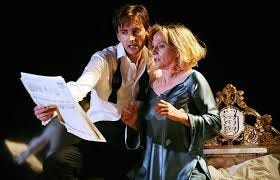
HAMLET
Nay, but to live
In the rank sweat of an enseamed bed,
Stew’d in corruption, honeying and making love
Over the nasty sty,--
Rank sweat: what is rank? Is that stinking? What do you smell when you smell stink? What things do you smell that stink? Do toilets stink? Do animals stink? Do humans stink? Do they stink when they fuck? What is that smell? Enseamed, what is enseamed? Is that pig-fat? Is that sperm? What does it look like? What does it smell like? What does it taste like? Is it sticky on the sheets? Stewed: what is that word? Is stew food? Have you eaten stew? Are the stews brothels? Is your mother a whore? Can you see your mother in a whore house? What is she wearing? How does she look at you? Honeying: Is honey what you call your lover in bed? Is honey sweet? What does honey taste like? How does it smell? Is honey sticky? Is semen sticky? Making love: Can you see her and this satyr making love? Can you hear them? Did they make love on this very bed? Within these sheets? Nasty sty – what are the pigs doing there? Can you hear them? How do they sound? Can you smell pig fat? Are you saying your mother is a pig?
These words and images were absorbed and metabolized by both actors – until one of them, Hamlet, unexpectedly hyperventilated.
I can still remember the actor rising out of his chair, trembling, unable to breathe, unable to say the words -- his entire body refusing to process the moment. The young man was in a physiological spiral of panic and dissociation. The actor playing Gertrude was shocked. Her partner, with whom she had been in genuine contact, suddenly broke off. The two were no longer in the same space.
Immediately, we halted the exercise and attended to the young man, who had to be calmed and restored.
The following day, we took up the remainder of the scene.
Immediately, we made an extraordinary discovery. Our Hamlet hyperventilated at the precise moment Shakespeare’s Hamlet sees his father’s ghost.
QUEEN No more!
HAMLET A king of shreds and patches—
Enter Ghost.
Save me and hover o’er me with your wings, You heavenly guards! —What would your gracious figure?
QUEEN Alas, he’s mad.
3.4.(117--121)
Hamlet sees the ghost. Gertrude doesn’t – an ontological rupture. Mother and son are in two different worlds.
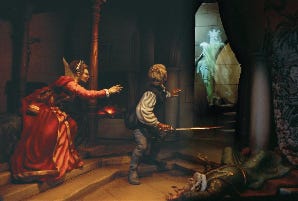
What causes this break in the actor’s consciousness, physically actualized in our rehearsal?
QUEEN To whom do you speak this?
HAMLET Do you see nothing there?
QUEEN Nothing at all; yet all that is I see.
HAMLET Nor did you nothing hear? QUEEN No, nothing but ourselves.
3.4. 149-53
Epistemological Dissociation:
Is Hamlet’s dissociation the result of the intensity of his machinations and manipulations? To catch Gertrude’s conscience, he stages a mini play within the bedroom using props – two contrasting portraits of the brothers. She begs her son to stop. He doesn’t. He can’t. He continues and intensifies his invective. His breaths shorten and accelerate. His mind goes spiraling off into another episteme – the shreds and patches of the Medieval universe. His father-king, in a nightshirt, not in armor, speaks to him of his almost blunted purpose.
Hamlet is engaging with a diminished, gentler image of his progenitor, but still a figure from purgatory – and the ghost speaks only to him – a speaking Gertrude does not apprehend.
In The Order of Things, Michel Foucault defines an episteme as a kind of horizon of understanding.
In any given culture and at any given moment, there is always only one episteme that defines the conditions of possibility of all knowledge, whether expressed in a theory or silently invested in a practice.vi
At this singular moment, Gertrude and Hamlet are in two different epistemes, the way Sancho Panza and Don Quixote are before the windmills, in Cervantes’ novel. vii
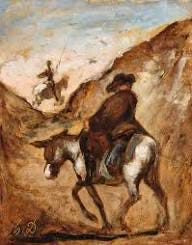
This is noble, righteous warfare, for it is wonderfully useful to God to have such an evil race wiped from the face of the earth.”
“What giants?” Asked Sancho Panza.
“The ones you can see over there,” answered his master, “with the huge arms, some of which are very nearly two leagues long.”
“Now look, your grace,” said Sancho, “what you see over there aren’t giants, but windmills, and what seems to be arms are just their sails, that go around in the wind and turn the millstone.”
“Obviously,” replied Don Quijote, “you don’t know much about adventures.”
― Miguel de Cervantes, Don Quixote
The medieval, vertical cosmos is fading. The Prince perceives his father in that cognitive space, in which both Hamlets seem depleted and exhausted. The queen sees vacancy –a tangible material world, with no ghosts.
At this key moment, we stand on the brink of two ontologies. Either this king of shreds and patches is real, and we are in the cosmos of Dante, OR it is a creature of Hamlet’s projection, and we are in the cosmos of Freud.
So where are we? Is the young Prince mad?
At the beginning of the play, Horatio, the skeptic, sees the ghost with his own eyes. viii
But in this closet scene – Who’s there?
Cause and effect.
The murder of Polonius sets off a chain of causality that will ultimately lead to the final act. Claudius sees through Hamlet’s crazy acting and realizes his nephew poses an imminent danger.
KING O heavy deed!
It had been so with us, had we been there.
His liberty is full of threats to all
To you yourself, to us, to everyone.
4.1. (13-16)
Claudius lives, as he always has, in the cosmos of pragmatism and power. His final solution to the Hamlet Problem is straight out of Machiavelli. Send the meddlesome Prince to England, where letters carried by Rosencrantz and Guildenstern will take care of things.
By letters congruing to that effect,
The present death of Hamlet. Do it, England,
For like the hectic in my blood he rages,
And thou must cure me. Till I know ’tis done,
Howe’er my haps, my joys will ne’er begin.’
4.3 (73-77)
Criss-cross:
At the sea’s edge, Fortinbras and his army, bound for Poland, cross paths with Hamlet and his entourage, bound for England. Knowing what we know about the end of the play, when Fortinbras rapidly and conveniently arrives to claim the throne, it’s not unlikely that his promised march over Denmark may be a ruse. In any case, Hamlet and Fortinbras glance, and glance off, each other at a crucial transit point – a hinge, if you will, in the entire play.
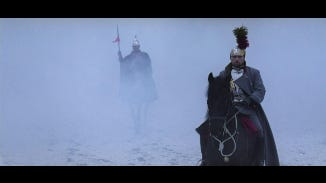
When their two fathers fought, the mighty King Hamlet, in full compliance with the Chivalric Code, didst slay the Mighty King Fortinbras. Back in those days, we knew where we were—in the heroic, Christian, neo-Platonic cosmos. And we knew what they were about -- ritualized combat in a hierarchical universe. To the winner goes the kingdom. That is the given meaning, a meaning that is preordained by fate and by the Will of God.
Now, in a different universe, the two sons encounter each other by happenstance, by slender accident, in an inconclusive world. We draw meaning not by interpreting revelation, but by observation and analysis, by relating what we experience to what we know about the world and ourselves. Now, we are in Montaigne’s episteme, not Mallory’s.
Hamlet’s Act 4 soliloquy, his last, is almost a personal essay. He is outside the event, looking in, attempting to find significance by examining his own empirical experience. In his previous soliloquys, he strained to the last forced suspiration to function in his father’s heroic universe, trying to find the meaningful action against the backdrop of the Trojan War – For Hecuba -- or trying to think it through, to make a choice between passivity and action, to suffer the slings and arrows of outragious fortune,/ Or to take arms against a sea of troubles.
As he leaves the stifling confines of the Court for his sea voyage, Hamlet has escaped that confined, hierarchical environment. He is in the open air, observing the heroic world from an ironic distance rather than trying to function in it.
I do not know
Why yet I live to say ‘This thing’s to do,’
Sith I have cause, and will, and strength, and means To do’t.
Examples gross as earth exhort me.
Witness this army of such mass and charge,
Led by a delicate and tender prince,
Whose spirit, with divine ambition puff’d,
Makes mouths at the invisible event,
Exposing what is mortal and unsure
To all that fortune, death, and danger dare,
Even for an eggshell.
4.4 (46-56)
Now our protagonist is outdoors, breathing fresh sea air, no longer in the labyrinthine, claustrophobic chambers of Elsinore. No more hyperventilating. No more windy suspiration of forced breath ix. The new breathing in this soliloquy is easier and more natural. The iambic pentameter is regular, no longer stressed, and hurried. The frenetic urgency is gone.
O, from this time forth,
My thoughts be bloody, or be nothing worth!
This concluding line is tacked on to an ironic observation that calls heroic death a fantasy, a trick of fame, His note-to-self dutiful, rather than inspired.
Hamlet is about to embark upon a sea voyage. By the time he returns to Elsinore, he will have entirely shed the cumbersome apparel of vengeance and heroics.
Diogenes Candle
10 May 2026
Footnotes:
You want a list? T.S. Eliot, Harod Bloom, Jacquiline Rose, Ernest Jones, Janet Adelman, Ernest Jones – on and on.
ii Diogenes considers himself blessed to have encountered training techniques that have served him throughout his career. The company’s methods, practiced and in many cases originated by Tina Packer, Kristen Linklater, Kevin Coleman, and so many others who taught and performed at The Mount, apply the totality of the text to the totality of the actor, iii Kirsten Linklater: Freeing the Natural Voice: Hollywood, Drama Publishers, 2006, p. 385 iv Catherine Byrne: The Pedegogy of Shakespeare & Company v This ontological rupture is a device Shakespeare would use again: the banquet scene in Macbeth. Macbeth sees the ghost of Banquo. Lady Macbeth doesn’t. Invariably, this forces a choice on the director’s part. To show or not to show? There could be an actor on stage, a shadowy projection or shadow, or a voice coming from afar. In The Scottish Play, it’s hard to resist staging Banquo’s return with all his gashes and gore.
vi Michael Foucault The Order of Things, An Archeology of the Human Sciences: New York; Vintage 1970, p. 168 vii Cervantes published his masterpiece in 1603, so he may have been writing it while Shakespeare was writing Hamlet. Something was in the air.
viii
BERNARDO
HORATIO
How now, Horatio! you tremble and look pale: Is not this something more than fantasy?
What think you on’t?
Before my God, I might not this believe Without the sensible and true avouch Of mine own eyes.
ix This performance doesn’t begin the monologue until 2 minutes in, so it makes the point about being outdoors. The actor does a fine job on the text.
x Seems, madam! nay it is; I know not ‘seems.’ ‘Tis not alone my inky cloak, good mother, Nor customary suits of solemn black, Nor windy suspiration of forced breath, No, nor the fruitful river in the eye, Nor the dejected ‘havior of the visage, Together with all forms, moods, shapes of grief, That can denote me truly: